The Difference Between N95, KN95 And FFP2 Masks
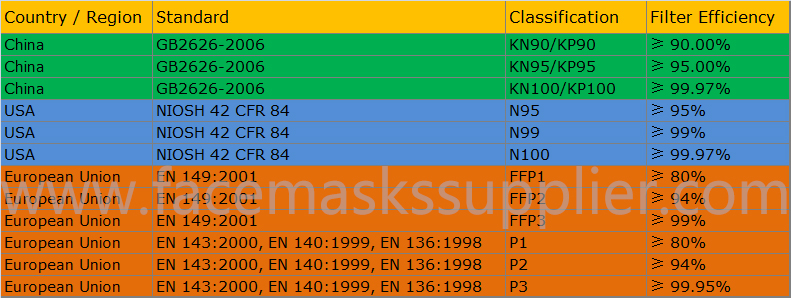
N95 is certified as the level of United States breathing apparatus, by the National Institute of Occupational Safety and Health (NIOSH). The N95 certified respirator has a filtration efficiency of not less than 95% of non-oily particles, and the mask must be marked "NIOSH" and "N95".
KN95 is a respirator with the certification level that complies with China's mandatory standard GB 2626-2006. The filtration efficiency of KN95 certified respirator is not less than 95% of non-oily particles, Bacterial Filtration Efficiency (B.F.E) ≧ 95.00%, Particle Filtration Efficiency (P.F.E) ≧ 95.00%., and the mask must be marked "GB 2626-2006 KN95".
FFP2 certified respirators reach the CE certification level that meet the European EN149 standard. Its filtration efficiency is not less than 94% of oily and non-oily particles. Masks must be marked with "EN 149: 2001 + A1: 2009 FFP2".
All of these respirators (protective masks) are designed to fit snugly over the face so that air can pass through the filter fabric of the mask rather than leak through the edge. All certified masks should be produced within a defined quality standard system.
Learn More about Face Mask Standards, Classes, Filter Efficiency.